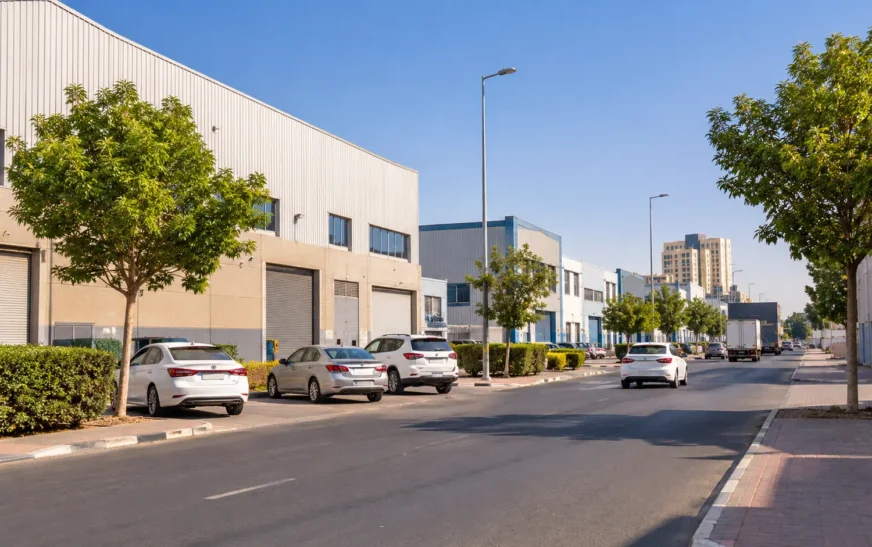
Industrial Area 2 is a working district in Sharjah, packed with workshops, warehouses, garages and trading units, and it sits close to the Dubai border. Property guides describe it as one of the emirate’s most active industrial districts, positioned between Dubai and Sharjah city. If you’re thinking of renting space, opening a workshop or simply working out whether the area suits your business, this guide covers the practical side: where it is, who operates there, what space costs, and what to verify before signing anything.
What Industrial Area 2 in Sharjah Is
Industrial Area 2 is one of several numbered industrial zones in Sharjah. The numbering can confuse newcomers, because Industrial Areas 1 to 18 are separate districts, each with its own character. Area 2 is not a free zone or a planned business park with a single master developer. It is a mainland industrial district with a mix of building types: standalone warehouses, workshop units, showrooms and small offices.
That mix explains much of its appeal. Listing platforms highlight its range of commercial property options and its proximity to Sharjah’s waterfront and cultural landmarks. The area is dense and busy, with heavy vehicles, forklifts and customers all sharing the same roads, so it suits operations that need street-level access more than quiet.
Where Industrial Area 2 Is and How to Get There
The location is the main reason businesses choose it. Sources describe the area as close to downtown Sharjah, served by Maliha Road, Al Khan Street, and the First and Second Industrial Streets. Several property guides also point to quick connections to the major highways, naming E11 and E311 as the routes that link businesses to ports, airports and other emirates.
Road naming in the UAE is confusing, and different guides use different route numbers for the same corridors. Check your delivery routes on a live map rather than relying on any single guide, and test the route at the times your trucks would actually travel.
Distances worth knowing
One area guide puts Sharjah International Airport about 14 kilometres away. Dubai is close enough that many businesses serve customers on both sides of the border. Treat all distances as approximate, since travel time depends far more on traffic than on kilometres.
Who Operates in Industrial Area 2
The area is known for practical, hands-on trades. Typical tenants include automotive workshops and spare parts suppliers, construction materials and equipment companies, packaging and printing firms, and furniture and woodwork businesses. Another local guide describes it as mostly workshops, warehouses, garages, spare parts shops and trading businesses.
| Business type | Why Area 2 suits it | What to check |
| Garages and workshops | Street frontage, heavy-duty power, easy customer access | Three-phase power, ventilation, permitted activity |
| Storage and distribution | Truck access and proximity to Dubai | Ceiling height, loading space, fire systems |
| Trading and spare parts | Visibility and passing trade | Signage rules, showroom frontage |
| Light manufacturing | Flexible unit sizes | Industrial licence, environmental approvals |
Not every unit suits every activity. A unit that works well for storage may not be approved for spray painting or metalwork, so match the unit to your exact licensed activity.
What Space Looks Like and What It Costs
Most availability is in small to mid-sized industrial units. Recent listings show typical specifications: a 3,200 sq ft warehouse advertised with 30 kW of electricity, a 3,500 sq ft unit with a mezzanine floor and easy truck entry and exit, and a 12,000 sq ft shed described as having a fully equipped fire system.
Indicative rents
Prices vary widely. In listings I reviewed, one 3,200 sq ft unit was advertised at AED 119,991 per year, and a 3,000 sq ft warehouse or garage at AED 140,000 per year. Treat these as asking prices on a single date, not market averages. They don’t reflect negotiation, fit-out condition, power capacity or lease terms. For a real benchmark, compare several current listings and ask a registered broker for recent transaction levels.
Features that change the value of a unit
- Electrical capacity: Machinery and workshops need adequate power. Ask for the sanctioned load in writing and confirm whether it is single or three-phase.
- Height and loading access: Shelving and container access depend on clear height and door size.
- Mezzanine or office space: Useful for admin staff, but confirm it is approved and not a later addition.
- Fire protection: Listings often mention fire systems, but only civil defence approval confirms compliance.
- Frontage: Main-road units cost more but suit trade businesses that depend on visibility.
Licensing and Approvals: What Applies
Renting a unit is only half the setup. Sharjah’s Economic Development Department (SEDD) issues the trade licence, and it is mandatory for commercial, professional and industrial businesses. Your licence category depends on what you actually do.
For manufacturing or processing, you’ll need an industrial licence. The activity list on a licence is specific rather than generic, so confirm your exact classification with SEDD or the relevant free zone authority before committing to premises or equipment.
There is recent news that may matter to manufacturers. SEDD announced an instant industrial licence priced at AED 1,000 in April 2026. Commentary on the scheme notes that this fee covers the licence only, and that industrial premises and environmental requirements still apply. Confirm current eligibility and conditions directly with SEDD, because schemes like this can change.
Warehousing activities may need further sign-off. One free zone guide notes that warehousing in Sharjah can require Sharjah Municipality approval after the trade licence is issued. Civil defence approval, environmental permits and tenancy registration may also apply depending on the activity, so ask SEDD and the municipality for the full list.
Mainland vs. Free Zone: A Quick Comparison
Industrial Area 2 is a mainland location, so it falls under SEDD rather than a free zone authority. Commentary on licensing notes that mainland businesses start with SEDD, while free zone businesses approach their own licensing authority.
| Factor | Mainland (e.g. Industrial Area 2) | Free zone (e.g. SAIF Zone, Hamriyah) |
| Licensing body | SEDD | The free zone authority |
| Local market access | Direct | Usually requires extra arrangements |
| Premises | Private landlord, open market | Zone-managed facilities |
| Best for | Local trade, workshops, walk-in customers | Export-focused or bonded operations |
Neither option is better in general. Choose based on who your customers are and how your goods move.
How to Choose a Unit: A Step-by-Step Approach
- Define the activity precisely: Write down exactly what you will do in the unit, including noise, fumes, storage of goods and customer visits.
- Confirm the licence category: with SEDD before viewing units, so you don’t rent something your activity can’t use.
- Shortlist three to five units: and compare power, height, access and condition, not rent alone.
- Visit at different times: A quiet Friday morning tells you little about weekday truck traffic.
- Request documents: title or ownership proof, tenancy contract template, utility accounts and any civil defence certificates.
- Check registration of the tenancy and understand who pays for maintenance, utility connection and repairs.
- Negotiate in writing: Rent-free fit-out periods and payment schedules are often negotiable, but only agreements in the signed contract count.
Common Mistakes to Avoid
- Renting before checking the licence: A unit that can’t legally host your activity is an expensive mistake.
- Trusting listing descriptions: Phrases like “suitable for any activity” are marketing, not legal approvals.
- Ignoring power capacity: Upgrading supply can be slow and costly.
- Overlooking parking and truck manoeuvring: Tight lanes and shared yards affect daily operations.
- Skipping a broker or legal check: Verify that the agent and the landlord are properly registered and that the permit number on the advert is valid.
Strengths and Limitations of the Area
Strengths
- Close to Dubai and to Sharjah’s main road links
- Broad range of unit sizes and types
- Established ecosystem of suppliers, mechanics and trading firms
- Generally lower cost than prime Dubai industrial locations (verify with current comparisons)
Limitations
- Congestion and heavy vehicle traffic
- Older buildings in some blocks, so quality varies
- Limited greenery, noise and dust typical of working industrial districts
- Compliance requirements that depend on your specific activity
Frequently Asked Questions
Is Industrial Area 2 in Sharjah close to Dubai?
Yes. It sits near the Sharjah–Dubai border, and local guides describe it as having direct highway access commonly used for daily travel to Dubai. Actual journey times depend on traffic.
What is Industrial Area 2 Sharjah known for?
Mainly workshops, garages, warehouses, spare parts shops and trading businesses, along with some packaging, printing and woodwork operations.
Do I need a licence to rent a warehouse there?
You need the right trade licence for your activity, issued by SEDD for mainland businesses. Some activities also need municipal or civil defence approval. Confirm this before signing a lease.
How much does a warehouse cost in Industrial Area 2?
Listings I reviewed asked roughly AED 120,000 to 150,000 per year for units of about 3,000 to 3,500 sq ft. These are asking prices and will vary by condition, location within the area and lease terms.
Is it suitable for a small business?
Often yes, since smaller units are widely available. But confirm that your licensed activity, power needs and access arrangements all fit the specific unit.
Final Thoughts
Industrial Area 2 offers a practical, well-connected base for workshops, storage and trading in Sharjah, especially for businesses serving both Sharjah and Dubai. The area rewards careful preparation. Settle your licence category first, compare units on power, access and compliance rather than rent alone, and put every agreement in writing.
Next step: contact SEDD to confirm your activity classification, then shortlist units and request the supporting documents before you commit. If you’re also comparing other Sharjah districts, explore our related area guides on Khaleej Edge.