
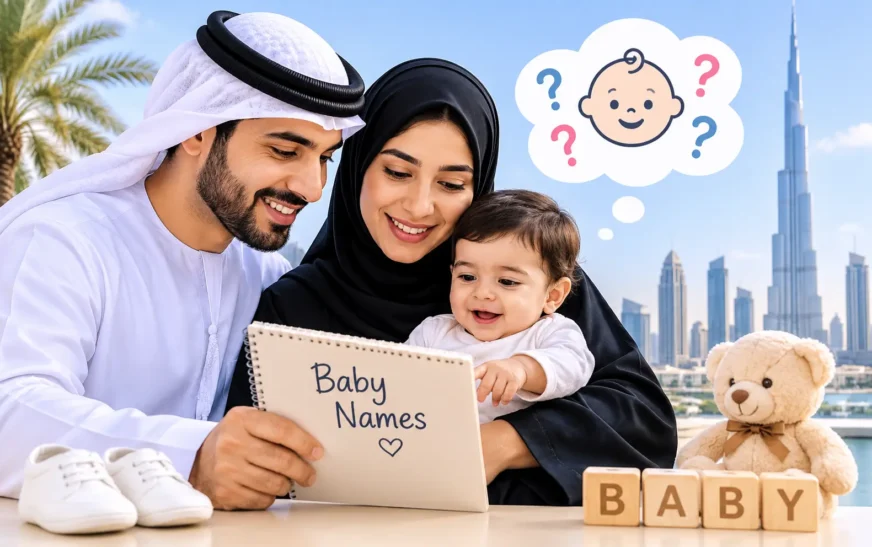
Having a baby in the UAE is an unforgettable experience, blending deep-rooted Islamic traditions with the fast-paced, multicultural life of cities like Dubai, Abu Dhabi, and Sharjah. Whether you are an Emirati family carrying forward generations of Gulf heritage or an expat couple starting your own chapter here, picking your baby’s name is one of the very first—and biggest—decisions you will make.
In Islam, a name isn’t just something printed on an Emirates ID or a passport. It is a lifelong identity, a silent prayer, and a reflection of your faith. At the same time, living in the Emirates means dealing with strict civil registration rules, Arabic-to-English spelling quirks, and tight government deadlines. Trying to balance spiritual meaning with UAE paperwork while you are exhausted in a maternity ward is no small task.
Here is a practical, down-to-earth guide to choosing a baby name in the UAE that honors your faith, respects local culture, and sails through civil registration without any headaches.
Start with the Islamic Foundation
Before you start scrolling through baby name apps or debating family favorites, it helps to ground your search in the Quran and Sunnah. In Islam, giving a child a good, dignified name (Husn al-Ism) is actually considered one of the baby’s fundamental rights over their parents.
Why a Name Carries Weight in Islam
The Prophet Muhammad (peace be upon him) reminded parents just how much a name matters, saying: “On the Day of Resurrection, you will be called by your names and by your fathers’ names, so give yourselves good names” (Sunan Abi Dawud). In fact, whenever the Prophet (peace be upon him) met someone whose pre-Islamic name meant something harsh, sad, or idolatrous, he would gently change it—turning Harb (war) into Silm (peace), and Huzn (grief) into Sahl (ease).
Four Types of Names Recommended in Islam
When you look at Islamic tradition, the best names usually fall into four clear groups:
- Names of Servitude to Allah (Abd + Al-Asma al-Husna): The Prophet (peace be upon him) specifically mentioned that Abdullah (Servant of Allah) and Abdul Rahman (Servant of the Most Merciful) are the most beloved names to Allah. Pairing Abd with any of Allah’s 99 Names—like Abdul Aziz, Abdul Kareem, or Abdul Malik—is always a timeless, blessed choice.
- Names of Prophets and Messengers: Naming your son or daughter after a Prophet connects them to stories of patience, courage, and devotion. Classics like Ibrahim, Yusuf, Isa, Musa, Nuh, Suleiman, and Muhammad never go out of style—and for girls, Maryam (Mary) holds the unique honor of being the only woman mentioned by name in the Quran.
- Names of the Sahaba and Righteous Figures: Naming a child after the Prophet’s companions or the Mothers of the Believers keeps Islamic history alive right inside your home. Think of strong, enduring names like Omar, Ali, Uthman, Hamza, Bilal, Khadijah, Aisha, Fatimah, and Zaynab.
- Names with Positive, Uplifting Arabic Meanings: You don’t have to pick a historical figure for a name to be “Islamic.” Any classic Arabic name that carries beauty, light, or good character is warmly encouraged—such as Noor (light), Zayd (growth), Rayyan (one of the gates of Paradise), Layla (night), or Amina (trustworthy and peaceful).
What to Avoid
Just because a word sounds Arabic doesn’t mean it makes a good Islamic name. Scholars advise staying away from:
- Names showing servitude to anything other than Allah: Names like Abdul Nabi (servant of the Prophet) or Abdul Shams (servant of the sun) go against the core Islamic belief of Tawhid (the Oneness of Allah).
- Allah’s exclusive titles without Abd: Names that belong strictly to Allah—such as Al-Ahad (The One) or Al-Khaliq (The Creator)—should never be used on their own for a person.
- Names with gloomy, arrogant, or harsh meanings: Anything tied to sadness, vanity, or notorious tyrants in Islamic history (like Fir’awn or Qarun) is best left off your list.
Know the UAE’s Legal Rules Before You Decide
Once you have a few faith-aligned names in mind, you need to make sure they pass muster with UAE authorities. Unlike some countries where parents can put almost any word on a birth certificate, the UAE has clear laws to protect a child’s dignity and respect public values.
What UAE Law Says About Baby Names
Under Wadeema’s Law (Federal Law No. 3 of 2016) and Federal Decree-Law No. 10 of 2022 (which governs birth and death registrations), parents must pick a name that is dignified and respects religious beliefs and public morals. While the government doesn’t hand out a public “banned list,” civil registry clerks will turn down any name that:
- Disrespects Islam, the Prophets, or religious symbols.
- Sounds insulting, demeaning, or likely to get the child mocked as they grow up.
- Clashes with public decency or local Emirati cultural values.
Double First Names and Paperwork Reality
Under Federal Decree-Law No. 10 of 2022, compound first names (like Muhammad Ali or Noor Al-Huda) are legally allowed on UAE birth notifications, provided they are respectful. That said, speak to any expat or local parent who has dealt with school admissions, airline tickets, or bank accounts here, and they will tell you the same thing: long, multi-word first names often get chopped up or scrambled across computer systems. Keeping the first name short and clear—separate from middle or father’s names—will save you and your child plenty of admin frustration later.
Quick Cheat Sheet: Islamic & UAE Naming Rules
| Type of Name | Islamic View | UAE Registration Status | Examples |
| Abd + Name of Allah | Most beloved (Mustahabb) | Fully accepted (watch spacing in Arabic) | Abdullah, Abdul Rahman, Abdulaziz |
| Prophets & Sahaba | Highly recommended | Fully accepted across all seven Emirates | Yusuf, Ibrahim, Omar, Khadijah, Aisha |
| Positive Arabic Words | Encouraged & permissible | Fully accepted if meaning is respectful | Zayed, Hamdan, Noor, Alia, Salma |
| Compound First Names | Permissible | Allowed under Federal Decree-Law No. 10 of 2022 | Muhammad Amin, Fatima Al-Zahra |
| Allah’s Names without Abd | Not allowed (Haram) | Rejected by civil authorities | Al-Khaliq, Ar-Rahman (standalone) |
| Offensive or Harsh Names | Not allowed (Haram) | Banned under Wadeema’s Law (Article 8) | Names implying humiliation or sin |
How Full Names Are Structured: Emiratis vs. Expats
Before you fill out hospital forms, it helps to know how the UAE formats full names:
- Emirati Nationals: Official documents follow the classic Arab lineage structure: [Baby’s First Name] + [Father’s Name] + [Grandfather’s Name] + [Family/Tribal Name], typically connected with bin (son of) or bint (daughter of) in Arabic.
- Muslim Expats: Your baby’s UAE birth certificate will generally pair their chosen first name with the father’s full name exactly as it appears on the father’s passport and Emirates ID. Double-check that your marriage certificate and passports match letter-for-letter before applying.
What’s Popular in the UAE Right Now?
Raise a child in the UAE and you will notice two distinct naming styles side by side: proud, traditional Khaleeji (Gulf) names and sleek, internationally friendly Islamic names popular among Dubai and Abu Dhabi’s global expat families.
Timeless Emirati & Gulf Favorites
In Emirati families, names carry deep family pride and respect for the nation’s heritage. Naming a firstborn after a beloved grandparent is still a cherished tradition here.
- Classic Emirati Boys’ Names: Zayed (growth and abundance—a tribute to the UAE’s Founding Father), Rashid (rightly guided), Hamdan (praised), Mansoor (victorious), Sultan (strength/authority), Khalifa (leader/successor), and Saif (sword).
- Classic Emirati Girls’ Names: Fatima, Latifa (gentle and kind), Mahra (high-born/foal), Shamma (pride and dignity), Moza (pearl), Hessa (destiny/pearl), and Mariam.
Modern, Global-Friendly Islamic Names
For expat parents—or bilingual families whose kids may study or work around the world—short, two-syllable names that sound natural in both Arabic and English are huge favorites:
- For Boys: Zayn (grace/beauty), Adam, Rayan, Kareem (generous), Tariq (morning star), Sami (elevated), and Idris.
- For Girls: Aya (a sign or Quranic verse), Sara, Lina (tender/palm tree), Jana (paradise/harvest), Zara (blossoming flower), Nadia (delicate/caller), and Hana (bliss).
A Simple 4-Step Check Before You Lock It In
If you are stuck between three or four favorites, run them through this quick four-step sanity check:
1. Check the Real Arabic Root
Don’t trust generic Western baby-name websites—they constantly mistranslate Arabic words or claim non-Arabic names come from the Quran. Look up the three-letter Arabic root in a reliable dictionary like Al-Maany, or ask an Arabic-speaking friend or local imam to verify what the word actually means.
2. Decide on the English Spelling Early
Because Arabic doesn’t use the Latin alphabet, there is no single official English spelling for most Islamic names. Muhammad alone can be written as Mohammed, Mohamed, Mohammad, or Muhammed.
- Look at how the father’s name or family surname is already spelled on UAE Emirates IDs and passports. Matching that same spelling pattern keeps your family’s paperwork consistent.
- Skip overly trendy spellings (like Zayyn or Aaysha) unless you want your child spelling their name out loud at every doctor’s office and airport counter for life.
3. Say the Full Name Out Loud
Say the first name together with the father’s name and last name a few times. Listen for awkward rhymes, tongue-twisters, or accidental double meanings when spoken quickly in either English or Arabic.
4. Make Sure Every Document Matches
In the UAE, your baby’s paper trail starts the moment the hospital nurse prints the Birth Notification. Whatever spelling goes onto that notification will carry over to the Birth Certificate, Passport, and UAE Residence Visa. Fixing a single typo later means formal applications, extra trips, and avoidable fees.
Balancing Sunnah Traditions with UAE Deadlines
Many new parents wonder how the traditional Islamic seventh-day naming custom fits into the UAE’s strict registration timelines. The good news is that both fit together naturally if you know the dates.
The 7th-Day Sunnah (Aqiqah)
In the Sunnah, it is recommended to officially announce your baby’s name, shave their hair (Halq) while giving the equivalent weight in silver to charity, and hold the Aqiqah (a sacrificial meal shared with family and those in need) on the seventh day after birth. Of course, if you already chose and used the name on day one, that is completely fine too.
UAE Birth Registration Windows
On the legal side, birth certificates are handled by your emirate’s health authority: the Dubai Health Authority (DHA) in Dubai, the Department of Health (DoH) in Abu Dhabi, and Emirates Health Services (EHS) across Sharjah, Ajman, Umm Al Quwain, Ras Al Khaimah, and Fujairah.
| Step | When to Do It | Where / Who Handles It |
| Hospital Birth Notification | Before discharge (Days 1–3) | Your maternity hospital prints the Arabic/English notification (locks in the name) |
| Sunnah Naming & Aqiqah | Day 7 after birth | Family announcement, Halq, silver charity, and Aqiqah gathering |
| Official Birth Certificate | Within 30 days of birth | DHA (Dubai), DoH / TAMM (Abu Dhabi), or EHS (Northern Emirates) |
| Passport & UAE Residency | Within 120 days of birth | Home country embassy (for expats) + ICP / GDRFA for Emirates ID and visa |
(Tip for Emirati parents: You can complete the birth certificate, family book update, passport, and Emirates ID in one go through the government’s Mabrouk Ma Yak digital bundle.)
Wrapping Up
Picking a baby name in the UAE is really about finding the sweet spot between faith, heritage, and everyday practicality. When you choose a name grounded in genuine, uplifting Arabic meaning—and double-check the spelling before the hospital prints that first birth notification—you give your child both spiritual blessing (Barakah) and a smooth start on paper.
May Allah bless your newborn, make them the coolness of your eyes, and grant them a life worthy of the noble name you choose for them.
Frequently Asked Questions (FAQs)
1. Can I register a non-Arabic Islamic name in the UAE?
Yes. Muslim names from Turkish, Persian, Urdu, or Malay backgrounds—such as Zoya, Aydin, or Mehmet—are accepted in the UAE as long as they carry a respectful meaning and do not clash with religious norms or public morals.
2. Is there an official list of banned baby names in the UAE?
No, the UAE doesn’t publish a list of banned names. However, under Wadeema’s Law (Federal Law No. 3 of 2016) and Federal Decree-Law No. 10 of 2022, authorities will reject any name that insults religion, offends public decency, or undermines a child’s dignity.
3. Are compound or double first names allowed in the UAE?
Yes. Under Federal Decree-Law No. 10 of 2022, compound first names (like Muhammad Ali) are legally permitted on birth notifications, provided they are respectful and align with public order.
4. How many days do I have to get a birth certificate in the UAE?
You have 30 days from the baby’s birth date to apply for and obtain an official UAE birth certificate. Waiting past 30 days can trigger late fines.
5. Which government body issues birth certificates in the UAE?
It depends on the emirate where your baby is born: the Dubai Health Authority (DHA) in Dubai, the Department of Health (DoH) via TAMM in Abu Dhabi, and Emirates Health Services (EHS) in Sharjah, Ajman, Umm Al Quwain, Ras Al Khaimah, and Fujairah.
6. Do we have to finalize the baby’s name before leaving the hospital?
It is strongly recommended. Hospitals need the baby’s name to issue the official Birth Notification at discharge. While you can technically leave it blank or amend it later, doing so involves extra paperwork and delays.
7. What is the deadline for an expat newborn’s passport and UAE visa?
Expat parents have 120 days from the date of birth to obtain their baby’s passport, Emirates ID, and UAE residence visa before daily overstay fines start accruing.
8. Is it mandatory in Islam to wait until the 7th day to name a baby?
No. Naming a baby on the seventh day alongside the Aqiqah is a recommended Sunnah, not a strict rule. You can name your child before birth or on the very day they arrive.
9. Can we change our baby’s name on a UAE birth certificate later?
Yes, though it takes a formal modification request through your emirate’s health authority (DHA, DoH, or EHS) with supporting IDs, marriage certificates, and fees—plus updating the child’s passport if you are an expat.
10. How do I make sure the English spelling of an Arabic name is right on UAE documents?
Verify the exact English letters with the hospital registration desk before they print the Birth Notification, making sure it matches the spelling style already used on the father’s passport and Emirates ID.