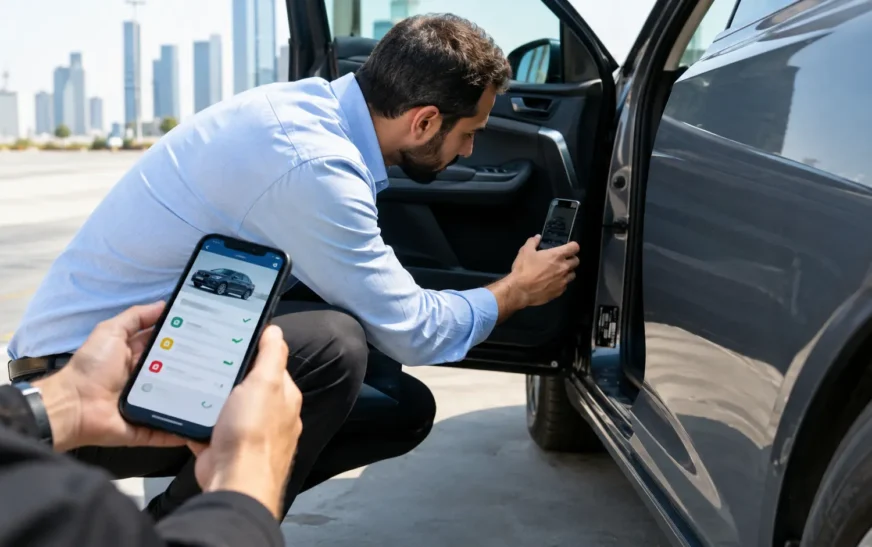
A chassis number check UAE takes only a few minutes and can keep you from buying a car with a hidden accident record or mismatched paperwork. You need the vehicle’s 17-character chassis number, also called the VIN, and an official source to run it through: the Ministry of Interior (MOI), Emirates Vehicle Gate (EVG), TAMM in Abu Dhabi, or, for Dubai cars, the RTA’s Technical Vehicle Status Report. Some of these lookups are free and one carries a fee. None replaces a proper inspection. This guide covers where to find the number, which service to use, what each one shows, and where the gaps are.
What a Chassis Number Is and Why It Matters
The chassis number is the vehicle identification number (VIN) assigned by the manufacturer. In the UAE the two terms are used interchangeably: portals and sellers say “chassis number”, while international databases say “VIN”. It is a 17-character code of letters and digits that stays with the car for life.
That permanence is the point. A plate number can change when a car is re-registered or moves between emirates, but the chassis number does not. Accident records, inspection results and registration history all hang off it.
What the 17 Characters Tell You
You do not need to decode a VIN by hand, but a few basics help you spot nonsense. The first three characters identify the manufacturer and region of build. The middle section describes details such as body style and engine. The final section is the individual serial number, and on many vehicles the tenth character indicates the model year.
VINs never use the letters I, O or Q, so a number containing them has been mistyped or is not genuine. If the year implied by the VIN differs from the year in the advert, ask the seller to explain.
Where to Find the Chassis Number Check UAE on a Car
Check at least two locations and make sure they agree:
- Windscreen: the bottom-left corner, readable from outside the car.
- Driver’s door jamb: a sticker or plate on the door pillar.
- Mulkiya: printed on the registration card.
- Insurance policy and service records: useful for cross-checking.
- Body or engine bay: stamped into the structure; the exact location varies by model.
Photograph the number on the car yourself rather than relying on a number the seller sends by message. If the windscreen number differs from the Mulkiya, or a stamped number looks scratched or re-engraved, stop. Mismatches can point to major structural repair, swapped parts or something worse, and they should be clarified with the relevant authority before any money changes hands.
Chassis Number Check Options in the UAE
Several official services accept a chassis number. They overlap, but they are not identical. The table below summarizes what UAE guides and the RTA’s own description indicate; confirm fees and requirements on the live page before you pay.
| Service | Best for | What you need | Cost |
| MOI accident inquiry | Accident record for cars registered anywhere in the UAE | Chassis number | Reported as free |
| Emirates Vehicle Gate (EVG) | Accident and insurance-related records | Chassis number | Guides disagree (free vs. AED 120); check at checkout |
| TAMM / Abu Dhabi Police | Accident inquiry for Abu Dhabi cases | Chassis number | Reported as free |
| RTA Technical Vehicle Status Report | Fuller history of Dubai-linked cars | Buyer and seller Emirates IDs, plate number or VIN, UAE PASS login | AED 120 |
In practice, a careful buyer runs the free accident lookup first, then uses the RTA report when the car is in Dubai or the purchase is large enough to justify the fee.
How to Run the Check, Step by Step
Accident History Through MOI, EVG or TAMM
- Get the chassis number from the car and from the Mulkiya, and confirm they match.
- Open the official service: the MOI accident inquiry, EVG, or, for Abu Dhabi, the accident inquiry on TAMM or the Abu Dhabi Police site. Type the address yourself or use the official app. Do not follow links from adverts or messages.
- Enter the 17 characters exactly, with no spaces. Because VINs exclude I, O and Q, read an ambiguous character as 1 or 0.
- Save a dated screenshot of the result.
- Compare the result with the listing and the seller’s claims, and ask about any difference.
Portal layouts and service names change. If the page looks different from what you expected, look for “accident inquiry” or “vehicle history”.
The RTA Technical Vehicle Status Report in Dubai
This is the most detailed official option. According to a recent Emirates 24|7 explainer based on the RTA’s service description, the process works as follows:
- Gather the buyer’s and seller’s Emirates ID numbers and the car’s plate number or VIN.
- Sign in at rta.ae with UAE PASS.
- Go to Services, then Vehicles, then “Apply for a Technical Vehicle Status Report”, and start the service.
- Enter the Emirates IDs and the plate or VIN, select the vehicle, and choose “Vehicle History Report”.
- The owner must agree to the disclosure of the vehicle’s data.
- Pay the AED 120 fee.
- Receive the report by email, or download it from the Certificates section of your dashboard. Processing is listed as one working day.
Older articles describe a different flow, with an SMS code sent to the owner and an AED 100 fee plus a separate AED 20 innovation fee. The total is the same, but the procedure has been updated, so follow what the live RTA page shows.
What the Reports Can Tell You
The accident lookups tell you whether an accident is on record against the chassis number. The RTA report goes wider. It is described as covering:
- Ownership history: past owners, registration dates and transfers.
- Insurance validity: whether and when cover lapsed.
- Inspection records: the last RTA test date and whether it was passed.
- Fines and legal claims: outstanding traffic fines and linked black points.
- Mileage log: odometer readings over time.
- Import details: country of origin and import date, where applicable.
The mileage log is especially valuable. A car that shows 118,000 km at its last test but 74,000 km on the dashboard needs a serious conversation, and possibly a walk away.
What a Chassis Number Check Cannot Tell You
The RTA itself states that its report contains only the information available when it is issued, and that data comes from several sources. A report may omit insurance or odometer entries if they were not on file. A clean result therefore means “nothing on record”, not “nothing happened”.
A few other limits are worth keeping in mind:
- Damage that was never reported, or repaired privately, may not appear anywhere.
- Records do not describe current mechanical conditions. A car can have a spotless history and a worn gearbox.
- A chassis check does not confirm GCC versus imported specification by itself. Verify specs against the manufacturer’s documents and the Mulkiya.
- Outstanding finance is a separate question. If the car is financed, ask for the bank’s clearance letter, which is normally part of the transfer paperwork.
This is why most advice pairs a record check with an independent inspection. If you want a reputable workshop to look at a car in Abu Dhabi, our guide to luxury car repair workshops lists options worth contacting.
Red Flags That Should Slow You Down
- The chassis number on the car, the Mulkiya and the insurance papers do not all match.
- A stamped VIN looks scratched, re-engraved or misaligned.
- The seller refuses to give consent for an RTA report or hesitates to share the number.
- The accident record contradicts what the advert said.
- The mileage log and the dashboard disagree.
- The car has an unexplained gap in registration or insurance history.
Here is a hypothetical example. A seller advertises a three-year-old SUV as “accident-free”. The MOI lookup returns nothing, which is reassuring but not conclusive. The RTA report then shows a failed inspection and a mileage reading far above the odometer. Neither finding appeared in the advert, and both give you leverage or a reason to leave.
A Practical Checklist Before You Pay
- Photograph the chassis number on the car and compare it with the Mulkiya.
- Run the accident inquiry on an official portal and save the result.
- For a Dubai car, request the RTA Technical Vehicle Status Report with the seller’s consent.
- Compare mileage, ownership and insurance history with what the seller told you.
- Ask whether the car is financed and, if so, how the bank clearance will be handled.
- Book an independent mechanical inspection before agreeing a price.
- Complete the transfer through official channels and check that the new registration shows the correct chassis number.
Common Mistakes to Avoid
- Using a third-party site for sensitive checks without verifying that it is official.
- Accepting a screenshot or PDF from the seller instead of running the check yourself.
- Treating a clean record as proof of a sound car.
- Paying a deposit before the checks are done.
Frequently Asked Questions
Is a chassis number check in the UAE free?
Most guides report that accident lookups through MOI and Abu Dhabi’s services are free. EVG guidance varies between sources, and the RTA Technical Vehicle Status Report costs AED 120. Confirm the fee on screen before paying.
Can I check a car’s history without the owner’s permission?
Accident inquiries are generally described as needing only the chassis number. The RTA report requires the owner’s consent and both parties’ Emirates IDs.
Is the chassis number the same as the engine number?
No. The engine number identifies the engine, while the chassis number identifies the whole vehicle. Both should match the car’s documents.
What if the report shows no accidents but the car looks repaired?
Trust what you see and get an independent inspection. Records can be incomplete, and unreported repairs will not appear.
How long does a chassis number check take?
Online accident lookups are typically instant. The RTA report is listed as taking one working day.
Conclusion
A chassis number check is the cheapest protection a UAE used-car buyer has. Confirm the number on the car matches the paperwork, run the official accident inquiry, add the RTA report for Dubai purchases, and treat the results as one input alongside a physical inspection. If anything does not match, pause the deal.
Before your next used-car search, save this checklist and run the checks before you pay a deposit. For more local guides, browse our Automotive section.