
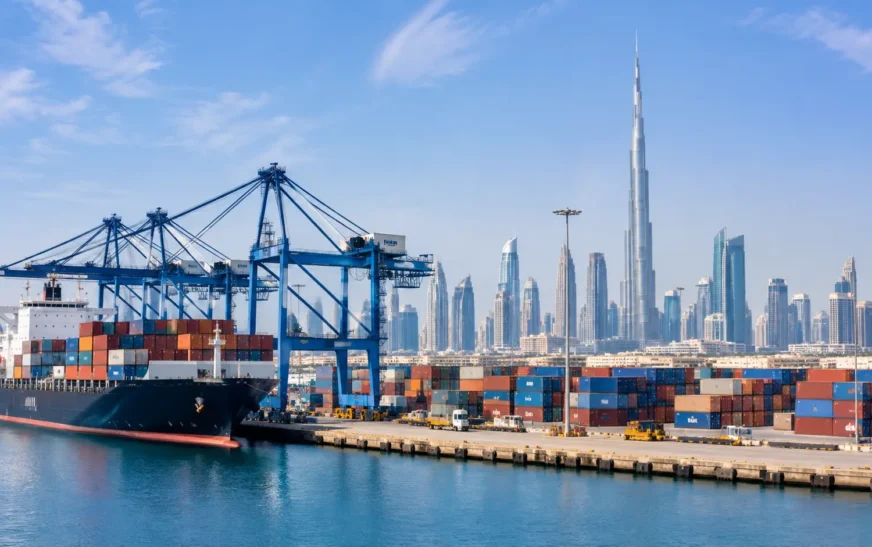
MENA Jebel Ali is the Dubai gateway through which a large share of goods bound for the Middle East, Africa and South Asia passes, which is why it sits at the centre of MENA trade. The name covers two linked assets: Jebel Ali Port, run by DP World, and the Jebel Ali Free Zone (Jafza), a business zone beside it that hosts more than 11,000 companies. This guide explains what each does, how large they are, what recent figures show, how businesses use them, and what to verify before relying on either, including the disruption seen in early 2026.
What Is MENA Jebel Ali?
Jebel Ali is an area on Dubai’s coast, south-west of the city centre, built around a deep-water port and an industrial and logistics free zone. The port opened in 1979; Jafza followed in 1985 with just 19 companies. Both are now part of DP World’s portfolio, and DP World describes Jebel Ali as the busiest port outside Asia (a company claim, so treat it as DP World’s own positioning).
Jebel Ali Port
The port has an annual container capacity of 19.4 million TEU (twenty-foot equivalent units, the standard measure of container volume) across four terminals, more than 100 berths and a 25-kilometre quay. It also has dedicated terminals for breakbulk (cargo that is not containerised, such as steel or machinery), roll-on/roll-off vehicles and heavy-lift items. That mix matters: Jebel Ali is a multipurpose port, not only a container terminal.
Jebel Ali Free Zone (Jafza)
Jafza offers offices, warehouses, land plots and light-industrial space within a zone linked directly to the port and close to Al Maktoum International Airport. In practice, a company can import goods by sea, store or process them, and ship them onward by air, sea or road without leaving one connected ecosystem.
Not to Be Confused With Palm Jebel Ali
If you searched “Jebel Ali” hoping for property news, note that Palm Jebel Ali is a separate waterfront development by Nakheel. This article covers the trade and logistics side only.
Why Jebel Ali Matters for MENA Trade
Three features explain its regional weight.
- Multimodal connectivity: Sea, air and road links sit within a short distance of each other, so cargo can change mode without long transfers.
- Range of cargo types: Containers, vehicles, bulk and breakbulk all move through the same port complex.
- Reach: Jafza’s operator says its infrastructure connects businesses to more than 3.5 billion consumers across the Middle East, Africa and South Asia.
For a manufacturer in India, a distributor in East Africa or an auto-parts exporter in China, Dubai often works as a regional distribution point: goods arrive in bulk, are sorted or repackaged, then sent to smaller markets. DP World has reported that China is Jebel Ali’s largest automotive trade partner, and that the port handled more than 960,000 vehicles in 2024.
A recent regional example is the announced return of the Iraqi Line, a national carrier whose first scheduled service was to run from Jebel Ali to Umm Qasr in southern Iraq from 15 October 2026. That is Iraq’s own announcement, so confirm operational details with the carrier.
Jebel Ali Port by the Numbers
The figures below come from DP World releases and Lloyd’s List reporting. Treat them as a snapshot; update them when new annual data is published.
| Metric | Figure | Source |
| Container throughput, 2024 | 15.5 million TEU, highest since 2015 | DP World |
| Container throughput, 2025 | About 15.55 million TEU, up 0.1% | Lloyd’s List |
| Annual container capacity | 19.4 million TEU | DP World |
| Lloyd’s List Top 100 ranking | Ninth (2025 edition, based on 2024 volumes) | Lloyd’s List |
| Breakbulk, 2025 | 5.67 million tonnes, highest in nearly two decades | DP World |
| Vehicles handled, 2025 | 1.5 million across Dubai terminals, up 18% | DP World |
| Single-month container record | 1.41 million TEU (December 2024) | DP World |
One detail deserves a closer read. DP World reported roughly 9% growth in origin and destination (O&D) volumes at Jebel Ali in 2025, while Lloyd’s List shows overall container throughput almost flat. O&D counts cargo that starts or ends its journey in Dubai and the UAE, whereas total throughput also includes transshipment, where boxes simply change ships. The gap suggests growth came from cargo bound for or leaving the UAE rather than from transshipment, although neither source reviewed breaks this down.
DP World also said around $3 billion of 2026 capital spending would go to priority projects including Jebel Ali, so capacity and terminal layouts may change.
How the Free Zone Fits In
Scale and Track Record
Jafza says it generated $190 billion in trade over the 12 months to May 2025, up 15% year on year, and that it hosts more than 11,000 companies from over 150 countries, including more than 100 Fortune Global 500 firms. DP World also reported AED 854 million in new investment attracted to Jafza in the first four months of 2026. A Jafza-authored business-council profile states that the free zone and port together contribute 36% of Dubai’s GDP (2023 figure); as it is self-reported, cite it as Jafza’s claim.
Who Typically Uses It
- Manufacturers and assemblers who want production close to a major port.
- Re-exporters and distributors serving several markets from one stock point.
- Automotive and spare-parts businesses, given the port’s vehicle volumes.
- Regional headquarters and trading companies that value access to sea, air and road links.
What to Check Before Setting Up
- Define your activity: Licence categories and permitted activities differ; confirm yours is covered.
- Compare licence structures: Jafza lists options such as FZE (single shareholder) and FZCO (multiple shareholders); check which suits your ownership.
- Confirm tax treatment: UAE corporate tax rules apply to free zone companies, and favourable treatment depends on meeting specific conditions. Take advice from a qualified UAE tax adviser rather than assuming exemptions.
- Plan mainland sales: If customers sit outside the free zone in Dubai, ask how distribution and customs work.
- Get written cost quotes: Licence, facility lease, visas and service fees vary by package; this article does not quote prices.
- Map your logistics: Check carrier schedules, customs clearance and inland trucking before committing to a unit.
Recent Disruption and What It Means
Jebel Ali’s record also needs context. In early March 2026, shipping agent GAC reported that port operations had been suspended and then resumed across Terminals 1 to 4 on 1 March at 18:00 GST, with enhanced safety and security measures. Later that month, DP World told Reuters the port was fully operational with no infrastructure damage, while acknowledging that inbound vessel traffic had fallen because of the regional conflict involving Iran. Portcast data for the week of 1 to 7 November 2026 showed low congestion, with a median vessel waiting time of 0.22 days.
The lesson is not that Jebel Ali is unreliable; it is that any single-hub strategy carries geopolitical and shipping-lane risk. Operating conditions can change quickly, so check current advisories from your carrier, freight forwarder or DP World before booking time-sensitive cargo.
Practical Tips for Businesses and Shippers
- Verify live status: Use DP World notices and your forwarder’s updates rather than relying on annual statistics.
- Build contingency routes: Ask your forwarder about alternative UAE ports and overland options.
- Match cargo to terminal: Containers, vehicles and heavy-lift items use different facilities, so confirm handling arrangements early.
- Separate growth from risk: Record volumes show demand; they do not guarantee your shipment’s transit time.
- Check data freshness: Port statistics are revised and republished, so cite the year and source.
Frequently Asked Questions
Is Jebel Ali the biggest port in the Middle East?
By container volume it is among the largest in the region and ranked ninth worldwide in Lloyd’s List’s 2025 Top 100 (2024 volumes). Rankings change annually, so check the latest edition before quoting.
What is the difference between Jebel Ali Port and Jafza?
The port handles ships and cargo; Jafza is the adjacent free zone where companies lease offices, warehouses and land. They are separate operations under DP World, designed to work together.
Is Jebel Ali Port open right now?
The port resumed normal operations on 1 March 2026 after a brief suspension, and early-November congestion data was low. Status can change, so confirm with DP World or your shipping line.
Do I need a physical presence in Jafza to use the port?
No. Many importers and exporters use Jebel Ali Port through forwarders without holding a free zone licence. Jafza is for businesses that want a licensed base inside the zone.
Does a free zone company pay UAE tax?
It depends on the company’s activities and whether it meets conditions for favourable treatment under UAE corporate tax rules. Consult a licensed UAE tax adviser.
Conclusion
Jebel Ali earns its place in MENA trade through scale, connectivity and a port-plus-free-zone model that lets cargo, storage and business operations sit side by side. Recent records in breakbulk and vehicles show strong demand, while the early-2026 disruption is a reminder to plan for contingencies.
If you are weighing Dubai as a regional base, start with your cargo profile and tax position, then request quotes and current operating updates directly from DP World, Jafza and your forwarder. Explore our related guides on UAE free zones and regional logistics for the next step.